Oct 6, 2026 Zoom Info Session - register to get link 5:00-6:00pm
Building Community Before the Homes Exist: Why Cohousing Begins Long Before Move-In
One of the things that makes cohousing unique is that the community begins long before the homes are built. At Gratitude Village Colorado, future residents are already building relationships through shared meals, Zoom meetings, volunteer projects, design workshops, and collaborative decision-making. This intentional approach to community living is at the heart of cohousing, creating trust, friendship, and a shared vision before anyone moves in. In this article, we explore why building community first leads to stronger neighborhoods, deeper connections, and a more resilient multigenerational cohousing community in Colorado.
Gratitude Village
7/2/20265 min read
Most neighborhoods are built before the neighbors ever meet. Gratitude Village is being built in exactly the opposite order.
By the time we move into Gratitude Village, we'll already know one another.
We'll know who makes the best scones, who loves to garden, who always volunteers to stack chairs after meetings, and who asks the thoughtful questions that make us stop and think. We'll know whose grandchildren visit every summer, who quietly notices when someone needs help, and who can always be counted on to bring dessert to a potluck.
That's not how most neighborhoods begin.
I always smile when I hear that because, not very long ago, almost none of us knew one another.
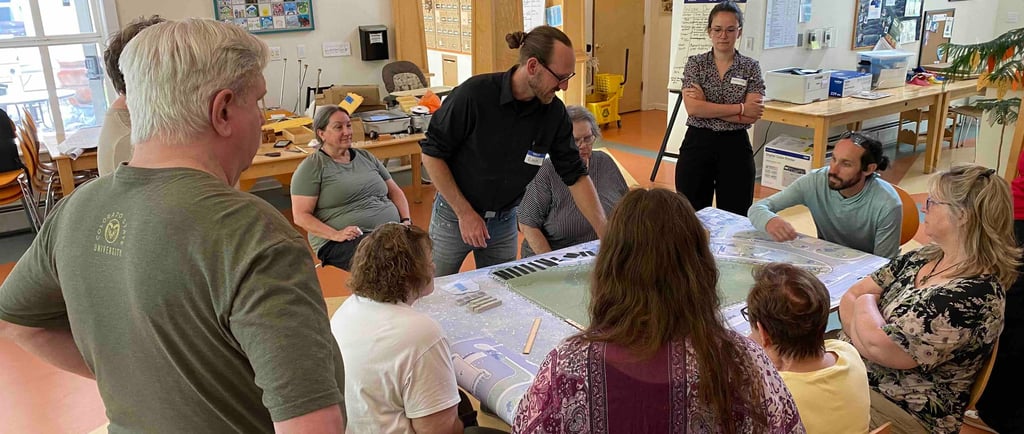
Some of our Founding Members met just over a year ago. Others joined the community only a few weeks before our Site Design Workshop. Yet somehow, by the time we spent an entire weekend designing our future neighborhood together, something had quietly changed. We weren't simply a group of people interested in cohousing anymore. We had begun to feel like a community.
That transformation didn't happen by accident.
One of the biggest misconceptions about cohousing is that the homes create the community. In reality, it's just the opposite. The relationships come first. By the time people move into a cohousing neighborhood, they have often spent months—or even years—getting to know one another, making decisions together, and learning how to navigate both the joys and challenges of community life.
In many ways, the homes are simply the physical expression of relationships that have already begun.
It Happens One Conversation at a Time
When people imagine creating a neighborhood, they usually picture architects drawing plans, construction crews pouring foundations, and homes slowly taking shape. What they don't see are the hundreds of conversations that happen long before the first shovel ever touches the ground.
Over the past eighteen months, our Founding Members have spent countless hours together on Zoom. We've celebrated new Founding Members, worked through due diligence on the Brighton property, debated everything from accessibility to affordability, and dreamed together about children playing beneath the cottonwood trees someday. We’ve lost some of our original founding members and have had conversations about how those departures left some of us feeling abandoned and hurt.
Those meetings weren't always easy, and they certainly weren't always exciting.
But relationships rarely grow because of exciting moments alone. They grow because people continue showing up for one another, week after week, conversation after conversation.
It Happens Around Shared Meals
If you've spent any time around Gratitude Village, you've probably noticed that food has a way of finding its way into almost every gathering.
We bring snacks to meetings. We organize potluck picnics. We linger over dinner at local restaurants. We celebrate birthdays and milestones. During our recent Site Design Workshop, our first "Common House" wasn't a building at all. It was two pop-up tents next to a grove of heritage cottonwood trees where we shared lunch together before walking the property.
There's something wonderfully ordinary about sharing a meal.
You stop being the person advocating for a particular design idea and become someone talking about your grandchildren, your favorite hiking trail, or the book you're currently reading. Those conversations may seem small, but they slowly transform a group of individuals into people who genuinely care about one another's lives.
It Happens Through Difficult Conversations
This may surprise people, but I don't think communities become strong because everyone agrees. In fact, I think the opposite is true.
Some of our greatest growth has come through working through difficult conversations with kindness and respect. We've had different opinions about governance, finances, design priorities, participation, and countless other decisions that naturally arise when creating something from scratch.
Consensus doesn't mean everyone gets exactly what they want. It means taking the time to listen deeply enough that a better solution has room to emerge. Sometimes that requires changing your mind. Sometimes it means letting go of your favorite idea because another approach better serves the community as a whole.
Every one of those conversations teaches us something about ourselves and about one another. More importantly, each one builds trust.
It Happens Through Showing Up
Community isn't built during the big milestones alone.
It's built when someone arrives early to help set up chairs. It's built when another person stays late to clean up after a meeting. It's built through volunteer hours, welcoming new members, checking in on someone who's had a difficult week, and offering encouragement when the road ahead feels uncertain.
Those moments rarely appear in newsletters or social media posts because they don't seem particularly remarkable.
But together, they become the invisible threads that weave a community together.
By the Time We Reached the Site Design Workshop . . .
When we gathered with Studio CoHab for our Site Design Workshop in June, people often commented on how naturally the group worked together. While there were certainly different perspectives—and occasionally lively discussions—there was also a noticeable sense of trust and respect in the room.
That trust didn't appear because we spent one weekend together.
It had been quietly growing for months.
It had grown through Zoom meetings where we wrestled with difficult questions. Through previous events like our Public Presentation in September 2025 or our Get It Built Workshop in January of this year. Through letting some consultants go and bringing on new team members. Through potluck dinners and shared picnic lunches. Through volunteer projects, board meetings, celebrations, disappointments, and all the ordinary moments that rarely receive much attention. By the time we sat down to design our future neighborhood, we had already spent months learning how to listen, how to collaborate, and how to create something together that was better than any one of us could have imagined alone (and we are still learning).
Looking around the room that weekend, I realized we weren't trying to become a community anymore. We already were one.
The Homes Simply Haven't Caught Up Yet
People often tell me they're excited to see Gratitude Village once it's built.
So am I. I cry every time we reach a new milestone. I look forward to the day when children are playing in the courtyards, neighbors are sharing meals in the Common House, and the pathways are filled with people greeting one another as they walk home.
But if I'm honest, I think something even more important is already happening. The relationships that will make those moments possible are being built today.
They are being built through conversations, shared meals, difficult decisions, volunteer projects, laughter, patience, and the quiet commitment of people who continue showing up for one another because they believe in something larger than themselves.
One day, the homes will be finished.
The Common House will open its doors.
Gardens will be planted, pathways will be well worn, and front porches will be filled with conversation.
When that day comes, we'll celebrate the completion of a beautiful neighborhood.
But we'll also know something many people never see.
The community was built long before the homes.
The homes simply had to catch up.
COMMUNITY
Join us in embracing nature, diversity and connection.
Sustainability
DIVERSITY
info@gratitudevillageco.com
720-689-4821
© 2026. All rights reserved.
AFFORDABILITY
Gratitude Village Inc. is a 501(c)3 charitable corporation (public charity) that values diversity, equity and inclusion as essential to our mission. EIN #33-2499522
Subscribe to our Substack
Refund Policy

Gratitude Village is a Proud Member of these organizations