Oct 17, 2026 IN PERSON Info Session - 10:30-11:30am Lakewood Library
Life Between the Buildings: Why Vibrant Neighborhoods Don’t Happen by Accident
Discover why “life between the buildings” is essential to vibrant, connected neighborhoods. This Gratitude Village Colorado blog explores how cohousing design, multigenerational living, and sustainable community planning—including Net Zero homes, passive solar orientation, and mixed-income affordability—foster belonging, everyday interaction, walkability, and resilience. Learn how intentional architecture, shared green spaces, and people-centered design create true community, reduce loneliness, and bring meaning back to daily life in Colorado.
Gratitude Village
11/26/20254 min read
On the cusp of a long holiday weekend, I stepped outside my front door and paused at the stillness. The sidewalks were empty. Driveways were quiet. A few garage doors were open because it's been ridiculously warm this fall here in Denver, but even those felt like silent invitations that no one intended to answer. It reminded me of the early days of the pandemic, when the world seemed to fold inward and we all kept our distance, unsure and isolated. Standing there, in this quiet suburban street, I felt again the absence of something essential—the life between the buildings that Danish architect Jan Gehl wrote about and that Charles Durrett often says is the beating heart of every thriving cohousing community. And it struck me, once again, why we are building Gratitude Village.
For most of us, the neighborhoods we live in weren’t intentionally designed to bring people together. Homes face the street, but rarely one another. Cars dominate the landscape. Front porches have disappeared. And despite having sidewalks, parks, and cul-de-sacs, spontaneous community is rare. The design itself encourages privacy but not connection. We can easily go days—or weeks—without interacting with the people who live closest to us. It’s not because we don’t care. It’s because the built environment doesn’t support the natural, everyday relational moments that turn neighbors into friends.
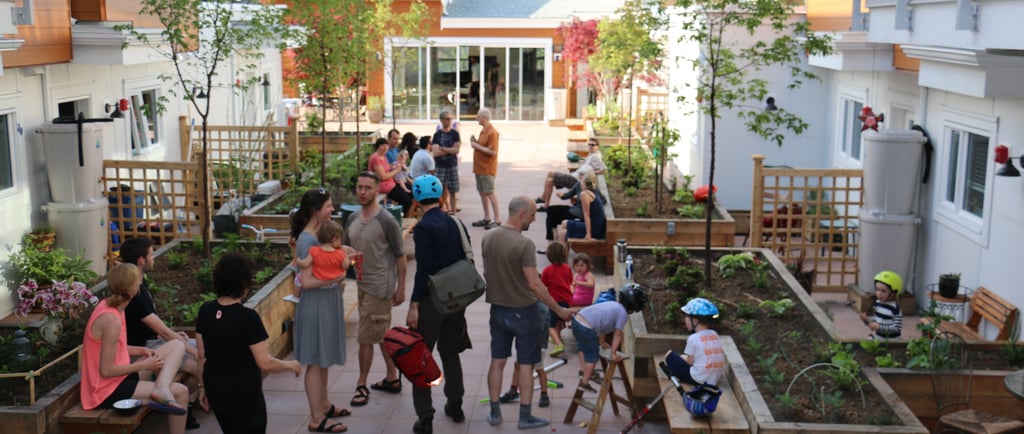
In cohousing, life happens differently. Charles Durrett describes “life between the buildings” as the magic that unfolds not inside your home, but in the shared pathways, courtyards, gardens, play areas, outdoor nooks and common spaces where people naturally encounter one another. It’s the lived experience of belonging. It’s where someone wanders out with a cup of coffee and ends up in a conversation that lasts an hour. Where kids spontaneously invent games while parents swap stories nearby. Where elders sit in the shade and offer wisdom to anyone who stops to listen. These are not forced interactions; they are simply made possible by thoughtful design.
Most of us long for these everyday connections, even if we don’t always have language for them. We want to live somewhere where it’s normal to eat dinner with neighbors once or twice a week. Where someone notices if you haven’t been outside for a bit and checks in to make sure you’re okay. Where it’s easy to ask for help carrying in groceries or share a few tomatoes from your garden. But longing alone isn’t enough. Without intentional design, these moments remain exceptions instead of the rhythm of daily life. Traditional neighborhoods rely on luck or a very determined neighbor. Cohousing relies on architecture, values, and community agreements that create the conditions for connection to thrive.
At Gratitude Village, this philosophy is central to everything we’re building. It’s why we design clustered homes around shared green spaces instead of isolating houses behind garages. It’s why our walkways are pedestrian-only, encouraging strolling, conversation, and play. It’s why the common house sits at the heart of the neighborhood: a warm, welcoming hub filled with shared meals, celebrations, book clubs, movie nights and the kind of unplanned interactions that make a place feel alive. Life between the buildings isn’t an afterthought; it’s the point.
During the pandemic, many of us realized how deeply we needed community. We learned that physical proximity does not automatically equal emotional connection. Even now, in the years since, many neighborhoods still feel quiet—people traveling, working long hours or retreating indoors to escape the pressures of daily life. The loneliness epidemic continues, affecting every generation in every corner of the country. And yet, when you visit a cohousing community, something feels different: vibrant, alive, human. You can hear laughter drifting across a courtyard. You can see children playing without traffic concerns. You notice the comfort on people’s faces because they know one another—not superficially but meaningfully.
This isn’t nostalgia or wishful thinking. Research shows that environments designed for walkability, gathering and shared purpose increase well-being, safety and mental health. People who live in community-rich settings are happier, healthier and more resilient. As Charles Durrett often notes, cohousing residents live longer not because of better medicine but because of stronger relationships. Life between the buildings quite literally supports life within them.
As we search for land for Gratitude Village—our ideal 6–12 acres oriented for passive solar, near parks, schools, transit, and community hubs—I imagine the future paths and courtyards already buzzing with energy. I can almost hear the clatter of dishes in the common house after a shared meal, the sound of kids laughing at the playground, the low hum of conversation on a summer evening as people gather outside to watch the sunset. I picture our gardens alive with color, our walkways lined with neighbors walking their dogs and our community rooms filled with art, music, meetings and celebrations of every kind. This is the antithesis of the quiet, empty street I saw this morning. This is a neighborhood where connection is built in from day one.
Life between the buildings doesn’t require extraordinary effort. It requires thoughtful choices: to design for walking instead of driving, for gathering instead of dispersing, for openness instead of isolation. It requires a willingness to share resources, conversations, meals and moments. And it requires a community of people—like the Founders, Explorers and future residents of Gratitude Village—who believe that neighbors should know one another, support one another and create a shared quality of life.
This holiday weekend, some streets may stay quiet, and many of us will feel that familiar longing for connection. But soon, Gratitude Village will be a place where no one wonders where the neighbors are—they are outside together, living life in ways that feel natural, joyful, and human. A place where a walk across the courtyard turns into an unexpected gathering. A place where children grow up surrounded by caring adults. A place where elders are woven into the rhythm of everyday life. A place where the space between the buildings is filled with laughter, movement, and belonging.
Because life between the buildings isn’t just a design philosophy. It’s the antidote to loneliness. It’s the heartbeat of community. And it’s the future we are building—together—at Gratitude Village.
COMMUNITY
Join us in embracing nature, diversity and connection.
Sustainability
DIVERSITY
info@gratitudevillageco.com
720-689-4821
© 2026. All rights reserved.
AFFORDABILITY
Gratitude Village Inc. is a 501(c)3 charitable corporation (public charity) that values diversity, equity and inclusion as essential to our mission. EIN #33-2499522
Subscribe to our Substack
Refund Policy


Gratitude Village is a Proud Member of these organizations