Oct 17, 2026 IN PERSON Info Session - 10:30-11:30am Lakewood Library
Pros and Cons of Cohousing: An Honest Look at Community Living
Cohousing offers a unique alternative to traditional housing by combining private homes with shared community spaces, fostering deep connection, long-term stability, and sustainable living. This article explores the most important pros and cons of cohousing, including community belonging, shared resources, affordability challenges, participation expectations, and collaborative decision-making. Learn how cohousing works in practice and why Gratitude Village is reimagining this proven housing model as a mixed-income, multigenerational, Net Zero community designed for belonging, resilience, and long-term affordability.
Gratitude Village
1/16/20264 min read
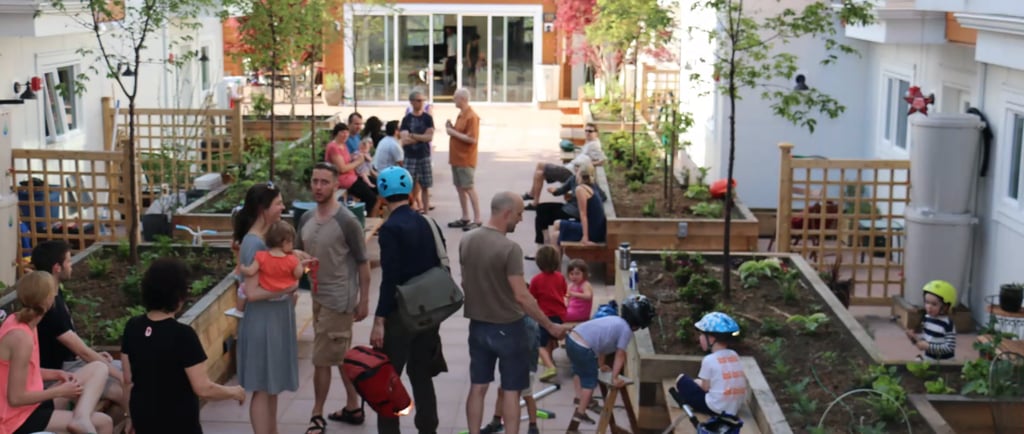
Image credit: The Cohousing Company, Charles Durrett.
Cohousing is often described as “the best of both worlds”—the privacy of your own home paired with the connection of a close-knit community. For many people, that idea feels both exciting and intimidating. At Gratitude Village, we believe it’s important to talk openly about both the benefits and the challenges of cohousing so future neighbors can decide whether this lifestyle truly aligns with their values and season of life.
Cohousing isn’t a trend or a utopian experiment. It’s a proven housing model that has existed for decades and continues to grow because it responds to very real modern challenges: loneliness, housing affordability, environmental impact and the loss of neighborhood connection. At the same time, cohousing asks more of its residents than a conventional subdivision or apartment building. It invites participation, patience and shared responsibility.
Below, we take an honest look at the most meaningful pros and cons of cohousing—especially as they relate to Gratitude Village’s vision of a mixed-income, fully-accessible, multigenerational, Net Zero community. If you’re exploring cohousing for the first time or trying to decide if it’s right for you, consider this your grounded, real-world guide.
🌿 PRO: Deep Community & True Belonging
One of the most powerful benefits of cohousing is the sense of belonging that naturally develops when neighbors design, build, and live together with intention. Unlike traditional neighborhoods where people may live side by side for years without really knowing one another, cohousing communities are designed to foster connection. Shared spaces like common houses, gardens, and courtyards create frequent opportunities for organic interaction. To further the opportunity for spontaneous connection, the community is people-focused, not car-centric with parking, garages and roadways on the periphery of the community – gardens and green spaces in the center. Homes face into the community, looking out on shared green spaces and walkways and they are built with large, inviting front porches. The back of the home is designed for privacy with bedrooms and living areas tucked to the rear and sometimes sheltered back patios.
This kind of proximity builds trust over time. Neighbors check in on one another, celebrate milestones together, and step in during difficult seasons. Children benefit from having many caring adults in their lives, while adults gain a wider circle of support that often replaces the fragmented social networks of modern life.
At Gratitude Village, community isn’t about forced togetherness—it’s about availability. You can close your door when you need privacy and open it when you’re craving connection. That balance is what turns neighbors into chosen family.
🌿 PRO: Stability & Long-Term Commitment
Cohousing communities tend to have much lower home turnover than conventional neighborhoods. While the average homeowner in the U.S. moves every 7–8 years, cohousing residents often stay in their homes for 15 years or more. This stability creates a powerful sense of continuity and emotional safety that is increasingly rare in modern housing.
Because people choose cohousing intentionally, they are more likely to see their home as a long-term investment—not just financially, but relationally. This long-term commitment allows communities to mature, deepen their culture, and build traditions that span generations.
For Gratitude Village, this stability is especially important. It supports aging in place, long-term affordability strategies, and the creation of a village that grows wiser and more resilient over time.
🌿 PRO: Shared Resources = Lower Costs & Lighter Footprint
Cohousing is built on the idea that sharing can reduce both costs and environmental impact. Instead of every household owning every tool, appliance, or guest space, communities share resources like guest rooms, workshops, gardens, laundry facilities, and common kitchens. This reduces redundancy and frees up both space and money.
Shared meals are another example. Cooking together several times a week can lower food costs, reduce waste, and save time—while also strengthening social bonds. From a sustainability perspective, cohousing communities consistently demonstrate smaller carbon footprints than traditional housing, and even those not focused on sustainability use 20-40% less energy than a traditional neighborhood.
At Gratitude Village, shared resources are also part of our affordability strategy. By designing smarter, smaller private homes alongside rich common amenities, residents get more value without needing more square footage.
⚠️ CON: Traditionally High Barriers to Entry
One of the most common challenges of cohousing has historically been access. Many cohousing communities require significant, upfront financial commitment, early involvement and the ability to wait several years for a project to be completed. This has often limited participation to higher-income households with flexible timelines.
Gratitude Village is intentionally working to change that narrative. As a nonprofit-led, mixed-income community, we are building pathways for a limited number of renters, first-time buyers and households at a range of income levels. Still, cohousing does require patience and early engagement, which can feel daunting to people used to faster, transactional housing options.
The upside is that those who stay the course help shape the community they will eventually call home.
⚠️ CON: Time & Participation Expectations
Cohousing works because people participate. Residents typically contribute time to community meals, committees, maintenance and governance according to their interests, skills and availability. While this shared workload replaces some of the invisible labor of managing a single-family home alone, it does require intentional time and energy.
For some, this feels life-giving. For others, especially during busy seasons, it can feel like one more obligation. Successful cohousing communities are transparent about expectations and flexible about how people contribute over time.
At Gratitude Village, participation is viewed as a shared responsibility that ebbs and flows. No one does everything, and everyone does something.
⚠️ CON: Slower, Collaborative Decision-Making
Unlike traditional housing developments where decisions are made by developers or HOAs, cohousing communities make decisions together. This collaborative approach leads to better, more inclusive outcomes—but it can take longer. Discussions, feedback loops and consent-based processes require patience and good communication.
For people accustomed to quick decisions, this can feel frustrating at first. Over time, however, many residents find that the tradeoff is worth it (and as the community develops, residents get better at joint decision making). Decisions may take longer, but they are better informed, more equitable and more durable.
Gratitude Village embraces this slower pace as a feature, not a flaw. It reflects our commitment to shared ownership and long-term success.
Is Cohousing Right for You?
Cohousing isn’t for everyone—and that’s okay. It’s a lifestyle rooted in values: connection, collaboration, sustainability and shared responsibility. For those who feel called to it, the rewards are profound.
At Gratitude Village, we believe the future of housing is neighborly, inclusive and intentional. Understanding both the pros and cons is the first step toward deciding whether this path feels like home.
COMMUNITY
Join us in embracing nature, diversity and connection.
Sustainability
DIVERSITY
info@gratitudevillageco.com
720-689-4821
© 2026. All rights reserved.
AFFORDABILITY
Gratitude Village Inc. is a 501(c)3 charitable corporation (public charity) that values diversity, equity and inclusion as essential to our mission. EIN #33-2499522
Subscribe to our Substack
Refund Policy

Gratitude Village is a Proud Member of these organizations