Oct 6, 2026 Zoom Info Session - register to get link 5:00-6:00pm
When a Dream Becomes a Place
What happens when the community you've been searching for doesn't exist? This month, I reflect on the journey from looking for a place to belong to watching future neighbors begin designing Gratitude Village together—and the moment I realized this was no longer just my dream.
Gratitude Village
7/4/20265 min read
For more than a decade, I was searching for a place I hoped already existed.
Like many people, I found myself drawn to the idea of cohousing long before I ever imagined starting one. I visited communities whenever I had the opportunity, read books and articles, attended presentations, and quietly imagined what it might be like to live in a neighborhood where people actually knew one another. I loved the idea of private homes combined with shared spaces, neighbors who gathered for meals and celebrations, and a community intentionally designed to foster connection rather than isolation.
If you had asked me three years ago where I saw myself in the future, my answer would have been simple: I hoped to become a resident of an existing cohousing community. At the time, starting one had never crossed my mind.
The challenge was that the more I looked, the more I realized the kind of community I wanted either wasn't available or wasn't financially attainable. The few new communities being developed in Colorado were beautiful, but they were also priced well beyond what I could afford. After spending ten years as a classroom teacher and another ten years leading a math learning center, I had recently retired with the retirement income of an educator—not a developer, entrepreneur, or tech executive.
I remember wondering how many other people were having the same experience. Surely I wasn't the only person who wanted a neighborhood centered on connection, sustainability, accessibility, and belonging but couldn't find one within reach. The more I thought about it, the more one simple question kept returning.
What if we built one ourselves?
At first, that question felt almost absurd. I had never developed real estate. I wasn't an architect, an engineer, or a land planner. I didn't know anything about zoning, environmental assessments, utility studies, financing, or entitlements. What I did know was education, building relationships, solving problems, and bringing people together. More importantly, I knew there had to be others looking for the same kind of community I was.
That question eventually became Gratitude Village.
Over the past two years, that single idea has grown into something I could never have imagined. We've incorporated as a nonprofit, assembled an extraordinary Board of Directors and professional development team, welcomed Founding Members and Exploring Members, secured a property under contract in Brighton, built relationships with the City of Brighton and countless community partners, and begun the complex work of transforming a vision into a real neighborhood.
Even with all of those milestones, there was still part of me that thought of Gratitude Village as something we were working toward rather than something that already existed. That changed last month.
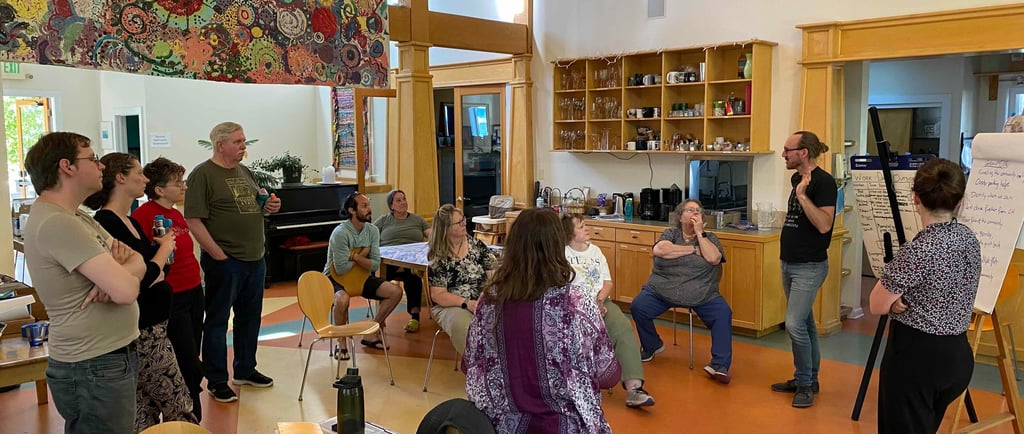
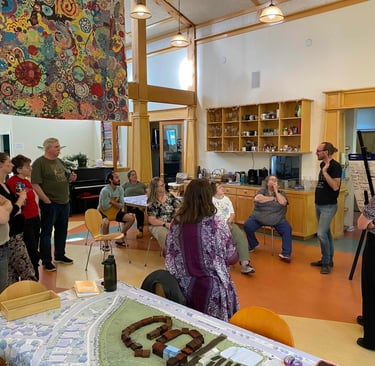
During our first Site Design Workshop, I watched future neighbors gather around maps of our Brighton property with wooden blocks representing different housing types, garages, the common house and commercial pads, pipe cleaners for paths and vegetation, black fabric strips for parking, brown ribbon for roads and other items. They debated where homes might fit best, how pathways could encourage spontaneous conversations, where gardens should be located, how children might safely explore the community, and what spaces would help neighbors connect every day.
What struck me wasn't that everyone agreed on every detail. In fact, they didn't—and that's exactly what made the experience so meaningful.
People listened to one another. They asked thoughtful questions. They built on each other's ideas. Someone would suggest moving the Common House to create a stronger sense of arrival. Another person would think about preserving a favorite gathering space. Someone else would notice an opportunity to make walking paths more inviting or improve accessibility for people with different mobility needs. Every conversation made the design a little stronger because every perspective mattered.
It was collaborative, creative, and deeply respectful. As I stood back and watched those conversations unfold, I realized I wasn't watching people design a future neighborhood. I was watching neighbors begin to build a community.
That's one of the beautiful paradoxes of cohousing. Most neighborhoods are designed first, built second, and only then do the neighbors arrive. Relationships develop later—if they develop at all. In cohousing, we reverse that process. We begin by building relationships, trust, and a shared vision. The physical neighborhood simply grows around the community that already exists.
In fact, I realized during the workshop that this process had already begun in ways I hadn't fully appreciated. As we gathered beneath a grove of heritage cottonwood trees to share lunch and conversation, it suddenly occurred to me that we were already sitting in our first Common House. There were no walls, no kitchen, no dining tables, and no fireplace—just two pop-up tents, picnic lunches, and future neighbors getting to know one another. Yet it was serving exactly the purpose a Common House is meant to serve: bringing people together. That moment inspired another reflection, "Our First Common House... Before There Were Even Walls," because it reminded me that community isn't created by a building. A building simply gives the community a place to gather.
Long before the first foundation is poured, people are learning how to make decisions together, solve problems together, celebrate together, and imagine a future together. By the time the homes are complete, the village isn't being created—it has already begun.
Long before the first foundation is poured, people are learning how to make decisions together, solve problems together, celebrate together, and imagine a future together. By the time the homes are complete, the village isn't being created—it has already begun.
Perhaps the greatest surprise for me was realizing that Gratitude Village no longer belongs to me. That may sound like an odd thing for a founder to say, but I believe it's exactly how it should be.
Every Founding Member brings their own experiences, hopes, talents, and ideas. Every new board member, volunteer, consultant, donor, and community partner leaves a fingerprint on this project. The neighborhood that eventually rises on our Brighton property won't look exactly like the sketches I made two years ago, and I'm grateful for that. It will be richer, wiser, more inclusive, and more resilient because it has been shaped by many voices instead of one.
In many ways, that's the true promise of intentional community. It's never about creating the perfect neighborhood. It's about creating a place where people are willing to listen, collaborate, compromise, and care for one another over the long term.
Looking back, it's amazing how much can grow from a single question. Not long ago, I was simply searching for a place where I might belong. Today, together with an extraordinary group of future neighbors and partners, we're creating one.
The homes haven't been built yet. The streets don't exist. The gardens haven't been planted, and the Common House hasn't welcomed its first shared meal. And yet, in the ways that matter most, Gratitude Village has already begun.
The dream has become a place—not because the buildings are finished, but because a community has chosen to build it together. I can't wait to see where we go from here.
COMMUNITY
Join us in embracing nature, diversity and connection.
Sustainability
DIVERSITY
info@gratitudevillageco.com
720-689-4821
© 2026. All rights reserved.
AFFORDABILITY
Gratitude Village Inc. is a 501(c)3 charitable corporation (public charity) that values diversity, equity and inclusion as essential to our mission. EIN #33-2499522
Subscribe to our Substack
Refund Policy
Gratitude Village is a Proud Member of these organizations