Sept 24, 2026 Zoom Info Session - register to get link 5:00-6:00pm
When the Dinner Bell Rings
In When the Dinner Bell Rings, we explore the power of shared meals as social infrastructure. From childhood memories of farm bells and family-style ranch dinners to the modern cohousing model, this piece examines how communal dining supports belonging, lowers stress, reduces the mental load on families, and strengthens intergenerational connection. It highlights how shared meals in intentional communities like Gratitude Village foster resilience, affordability, sustainability, and everyday relationship-building — proving that where we eat may matter just as much as where we live.
Gratitude Village
3/15/20264 min read
There is something ancient about the sound of a dinner bell.
I remember hearing one ring out across the farm in western Oklahoma — a big metal bell mounted near the house — calling the boys in from the fields when we were visiting friends of my grandparents. Work paused. Dust settled. Boots turned toward home.
Years later, working at a dude ranch the summer after high school, meals were announced by clanging a large metal triangle hanging outside the dining hall. Guests drifted in from horseback rides and long hikes. As a server, I even got to ring it sometimes. It was simple, loud and a little joyful.
The sound meant something.
It signaled more than food. It meant someone had prepared something. It meant there was a place set for you. It meant the day, however scattered, was gathering itself into a shared pause.
In most modern households, dinner is logistical. Who’s home? Who’s late? What’s quick? What can be reheated? What can be eaten between commitments? The meal becomes another task to complete before collapsing into the evening.
But shared meals change the rhythm of a day.
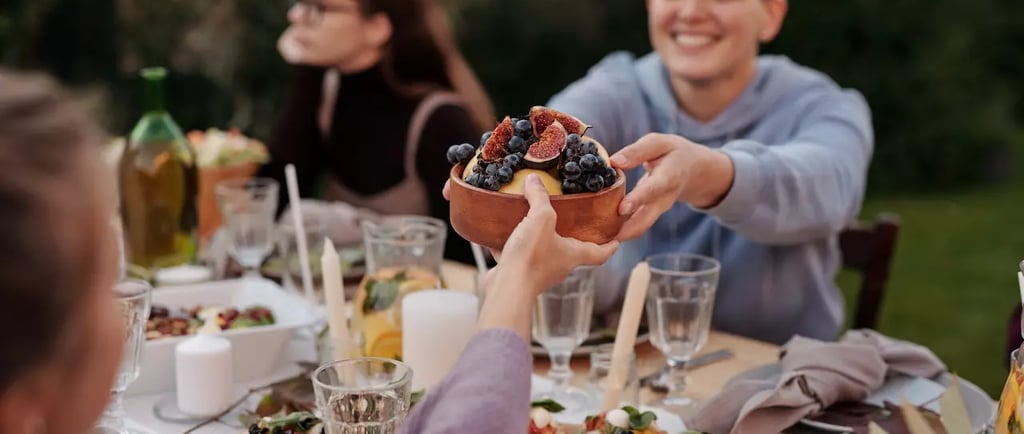
In cohousing communities, the common house kitchen becomes a quiet heartbeat. Several times a week, dinner is prepared not by every household independently, but by a rotating team. One group cooks. Another cleans. Children weave in and out of the space. Someone sets the long tables. Someone slices bread. Someone stirs a pot that fills the room with steam and scent.
And when the bell rings — or the message goes out — people walk over.
Not dressed up. Not performing. Just arriving.
There is something profoundly regulating about eating together. When we sit at a table with others, our nervous systems soften. Conversation slows our breathing. Laughter lowers cortisol. Eye contact signals safety. The simple act of sharing food shifts the body from vigilance to rest.
We are wired for communal meals.
Long before neighborhoods were plotted and kitchens were individualized, humans gathered around firelight. Food was shared because survival depended on it. Stories were told because memory mattered. Trust was built because the group endured together.
Shared meals are not a lifestyle trend. They are a biological memory.
Somewhere along the way, dinner became individualized. Each household an island. Each grocery bill private. Each parent quietly carrying the invisible labor of planning, preparing and cleaning — often alone.
Shared meals redistribute more than food.
They redistribute effort.
In a community of twenty households, if each cooks once every few weeks, the math shifts dramatically. Instead of planning and preparing dinner seven nights a week, you cook one large meal occasionally and enjoy the rest. The burden lightens. The mental load softens.
The impact on families is tangible. Parents sit instead of scrambling. Children eat alongside adults who are not their own. Teens linger longer at tables when conversation stretches across generations. Elders are not eating alone in quiet kitchens.
Kids run between tables. Someone drops a napkin. Someone tells a story that grows taller with every retelling. There is background hum — not chaotic, but alive. The kind of sound that signals safety. The kind that lets your shoulders drop without realizing they were tense.
And then something subtle unfolds: familiarity.
You learn who prefers extra sauce. Who avoids dairy. Who makes extraordinary bread. Who always brings herbs from the garden. These small details accumulate into knowledge. Knowledge becomes care. Care becomes trust.
Shared meals also create rhythm.
In traditional neighborhoods, connection requires scheduling. In cohousing, it is woven into the week. You don’t have to manufacture reasons to gather. The design supports repetition — and repetition builds relationship.
There are practical benefits, too. Buying in bulk reduces waste. Cooking collectively lowers per-household costs. Food scraps move to compost that nourishes the garden. The system becomes cyclical instead of isolated.
But the deepest benefit is quieter.
It is the relief of not eating alone.
It is the comfort of knowing that even if your day was hard, there is a table where you are expected. It is the small but powerful experience of walking across a courtyard with an empty plate and returning with it full.
Privacy still exists. No one is required to attend every meal. Doors close when families need quiet. But the option remains — and that option changes how people move through their week.
At Gratitude Village, the common house is not just square footage. It is social infrastructure. It is preventative health. It is accessibility in action. It is climate resilience through shared resources. It is children growing up watching adults cook together instead of in isolation.
It is the echo of a bell across a courtyard and neighbors stepping outside.
When the dinner bell rings, something more than hunger is satisfied.
We remember that we are not meant to navigate daily life alone.
And in a world that increasingly fragments us into private kitchens and parallel routines, that simple act — gathering at a long table — may be one of the most radical things we can design.
Maybe the future of housing isn’t just about where we sleep.
Maybe it’s about where we eat.
Together.
If you’re new to the idea of cohousing, this kind of everyday connection might feel both familiar and surprising. We explore that more deeply in “What If We Weren’t Meant to Live This Way?”, where we look at how modern neighborhoods have shaped isolation—and what becomes possible when we design for connection instead.
COMMUNITY
Join us in embracing nature, diversity and connection.
Sustainability
DIVERSITY
info@gratitudevillageco.com
720-689-4821
© 2026. All rights reserved.
AFFORDABILITY
Gratitude Village Inc. is a 501(c)3 charitable corporation (public charity) that values diversity, equity and inclusion as essential to our mission. EIN #33-2499522
Subscribe to our Substack
Refund Policy


Gratitude Village is a Proud Member of these organizations