Oct 17, 2026 IN PERSON Info Session - 10:30-11:30am Lakewood Library
Zoning Challenges: Why Our Systems Weren’t Designed for Community
Cohousing communities often challenge modern zoning and development systems because many of those systems were originally designed around separation, automobile dependence, and conventional suburban housing patterns rather than shared community life. Zoning Challenges: Why Our Systems Weren’t Designed for Community explores how cohousing developments like Gratitude Village must navigate regulations related to parking, density, shared spaces, accessibility, and land use while introducing a different vision for neighborhood design. As Gratitude Village Colorado continues working with the City of Brighton to plan a mixed-income, fully accessible cohousing community, this article offers a thoughtful look at the broader cultural and structural challenges involved in creating neighborhoods intentionally designed for connection, sustainability, and belonging.
Gratitude Village
6/2/20264 min read
One of the things we have learned throughout the development process at Gratitude Village is that many of our modern systems were not built with intentional community in mind. Zoning codes, subdivision regulations, parking requirements, financing structures, and development processes were largely designed around a very different model of housing—one centered on separation, private ownership, automobile dependence, and clearly divided land uses. In many ways, cohousing communities ask different questions about how people live together, and that often creates friction within systems that were never designed to accommodate those priorities easily.
Most people rarely think about zoning unless a new development appears near their neighborhood. Yet zoning quietly shapes almost every aspect of our built environment. It determines where homes can be built, how dense neighborhoods can become, whether businesses and housing can exist near one another, how much parking is required, how roads are designed, and even how people move through daily life. Over time, many zoning systems in the United States evolved around assumptions that prioritized cars, private space, and separation between residential, commercial, and civic life. As we explored in What If We Weren’t Meant to Live This Way?, many modern neighborhoods unintentionally reinforce isolation simply through the way they are physically organized.
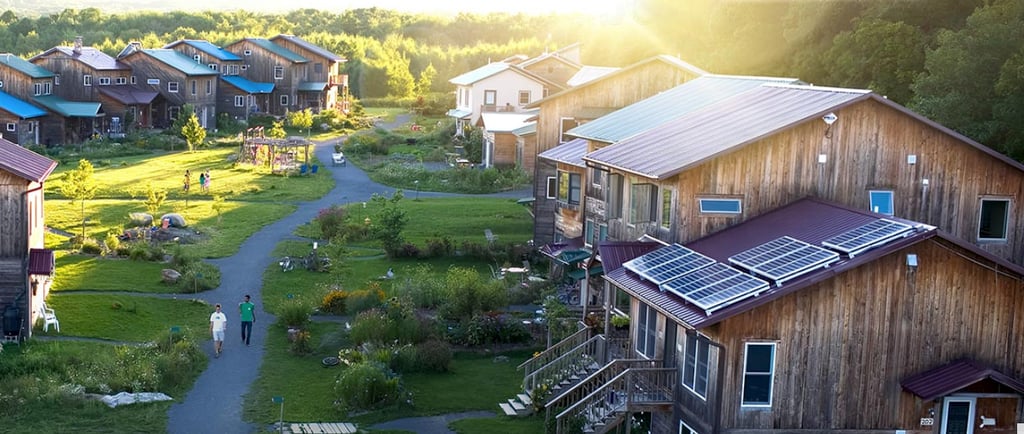
Cohousing communities often challenge some of those assumptions. Rather than maximizing separation between households, cohousing intentionally creates opportunities for interaction and connection. Homes are typically designed around shared greens, pedestrian pathways, common houses, and gathering spaces rather than wide roads and isolated backyards. Shared amenities reduce the need for every household to duplicate every resource independently. Walkability and social connection become part of the design itself rather than accidental byproducts. These differences may sound subtle, but they can create meaningful complications when projects move into traditional zoning and entitlement systems.
One example involves parking requirements. Many municipal codes assume a certain number of parking spaces per home based on conventional suburban development patterns. Yet cohousing communities often aim to reduce dependence on cars by encouraging walkability, shared resources, remote work opportunities, bike access, and stronger neighborhood connectivity. Large parking minimums can consume land that might otherwise become shared green space, gardens, gathering areas, or more accessible pedestrian pathways. In some cases, communities must spend significant time working with municipalities to explain why alternative site layouts may better support the goals of the project.
The same is true for shared spaces themselves. Traditional development patterns often prioritize private square footage within individual homes, while cohousing intentionally shifts some functions into common areas. Shared kitchens, guest rooms, workshops, laundry facilities, gardens, co-working spaces, and gathering rooms can reduce duplication while strengthening community life. As we discussed in The Dinner Bell Rings – Why Common Meals Matter, many of the most meaningful interactions in cohousing happen through ordinary shared experiences woven into daily life. Yet zoning and financing systems do not always know how to categorize or evaluate these types of spaces because they fall somewhere between private and public infrastructure.
Density can also become a complicated conversation. In many communities, density is often discussed negatively, associated with traffic, overcrowding, or strain on infrastructure. But density itself is not inherently harmful. The design and functionality of a neighborhood matter enormously. A thoughtfully designed pedestrian-oriented community with shared spaces, accessible pathways, and intentional gathering areas can feel dramatically different from a conventional high-density development focused primarily on maximizing units. Cohousing communities attempt to balance privacy with connection, creating environments where people can interact naturally without sacrificing personal space.
At Gratitude Village, we have experienced firsthand how much education and collaboration are required throughout this process. Many city officials and planning staff have never worked directly with a cohousing development before. That does not mean they are opposed to it. In fact, we have been encouraged by many of the thoughtful conversations we have had with municipal leaders, planners, and development professionals. But unfamiliarity naturally creates additional questions. How should parking be evaluated? How do shared amenities factor into planning requirements? How can accessibility, mixed-income housing, sustainability, and community space be balanced within existing development frameworks? These are not always simple conversations because the systems themselves were largely designed around different assumptions about how neighborhoods function.
One of the more surprising things we have learned is how interconnected everything becomes. A decision about parking affects walkability. Walkability affects opportunities for social interaction. Shared spaces affect infrastructure calculations. Density affects affordability. Accessibility affects circulation design. Sustainability affects building orientation and site planning. None of these elements exist independently. In many ways, cohousing challenges the tendency to separate housing, transportation, environment, and social well-being into isolated categories. It asks communities to think more holistically about how neighborhoods actually support human life.
There is also a deeper cultural layer beneath many zoning conversations. Over the past century, American housing patterns have increasingly emphasized privacy, autonomy, and separation. Many people genuinely value those things, and cohousing is certainly not about eliminating privacy or independence. But intentional communities do challenge the assumption that isolation should be the default structure of neighborhood life. They ask whether people might benefit from environments designed to support more interaction, collaboration, accessibility, and mutual support. As we explored in How Cohousing Works (And Why It Feels So Different), the physical layout of a neighborhood profoundly shapes the rhythms of daily life and the kinds of relationships that naturally develop within it.
In some ways, this is why cohousing projects can take longer to move through approvals and planning processes. The challenge is not simply regulatory complexity. It is that these communities often do not fit neatly into categories designed for more conventional forms of development. Every shared space, pedestrian pathway, accessibility feature, or mixed-use element may require additional explanation, collaboration, and flexibility. That process can occasionally feel frustrating, but it can also create opportunities for important conversations about what kinds of neighborhoods our communities actually need moving forward.
At Gratitude Village, we do not see these conversations as obstacles alone. We see them as part of a broader cultural transition already beginning to happen in many places. Across the country, people are rethinking loneliness, housing affordability, aging in place, environmental sustainability, accessibility, and the long-term impacts of car-dependent development patterns. More people are questioning whether our neighborhoods are truly supporting health, belonging, and resilience in the ways many of us need. Cohousing does not offer a perfect solution, but it does provide one possible model for thinking differently about how communities can function.
Ultimately, zoning systems reflect cultural values as much as technical rules. They shape what kinds of neighborhoods are easy to build and which ones require extra persistence, education, and advocacy. At Gratitude Village, we are learning that building intentional community is not only about designing homes or shared spaces. It is also about helping systems slowly adapt to new ways of thinking about connection, accessibility, sustainability, and neighborhood life itself.
COMMUNITY
Join us in embracing nature, diversity and connection.
Sustainability
DIVERSITY
info@gratitudevillageco.com
720-689-4821
© 2026. All rights reserved.
AFFORDABILITY
Gratitude Village Inc. is a 501(c)3 charitable corporation (public charity) that values diversity, equity and inclusion as essential to our mission. EIN #33-2499522
Subscribe to our Substack
Refund Policy


Gratitude Village is a Proud Member of these organizations