Oct 17, 2026 IN PERSON Info Session - 10:30-11:30am Lakewood Library
The Spaces Between the Homes
Why do some neighborhoods naturally foster friendships while others leave us feeling anonymous? In this article, we explore the idea of "life between the buildings"—the shared spaces where everyday interactions become lasting relationships. Through a personal story and the design principles behind cohousing, discover how Gratitude Village is intentionally creating a neighborhood where connection isn't left to chance, but thoughtfully woven into the places between the homes.
Gratitude Village
7/15/20265 min read
Some of my favorite childhood memories don't take place inside a house.
They take place in the front yard of my grandparents' home in a small town in western Oklahoma. Their house didn't have air conditioning, just open windows and a few fans that worked overtime during the summer. After supper, everyone simply moved outside. My grandparents settled into lawn chairs while their best friends wandered over almost every evening. Other neighbors stopped by whenever their schedules allowed. Someone was usually snapping green beans, shelling peas, or shucking corn while the conversation drifted from family news to local happenings to stories that had probably been told a hundred times before.
My sister and I played in the yard or the driveway, sometimes with other children and sometimes on our own, always within earshot of the adults. Looking back, I don't remember many of the conversations. What I remember is the feeling. I remember knowing the people around us, feeling safe, and somehow understanding that our lives were connected in ways I couldn't yet describe.
Those memories were reinforced in the Denver neighborhood where I grew up. I remember riding my bike until the streetlights came on, neighborhood-wide games of tag that spilled across half a dozen front yards, and hopscotch games stretching down the sidewalk in colorful chalk. On warm summer evenings, it seemed like every front porch or front stoop had someone sitting outside while children played. If you walked down the block, you rarely made it home without stopping to say hello to someone. At the time, I assumed every neighborhood worked that way.
As I grew older, I realized they didn't.
Somewhere along the way, many of our neighborhoods changed. Homes became larger. Garages moved to the front. Backyards became more private. Air conditioning meant windows stayed closed through the summer. None of those changes were wrong. They reflected changing lifestyles, growing communities, and new priorities. But together they quietly changed where life happened. Instead of gathering in front yards, we gathered in backyards. Instead of sidewalks filled with children and neighbors, we drove into our garages, closed the door, and went inside. We still had wonderful homes, but we had fewer opportunities to simply bump into one another.
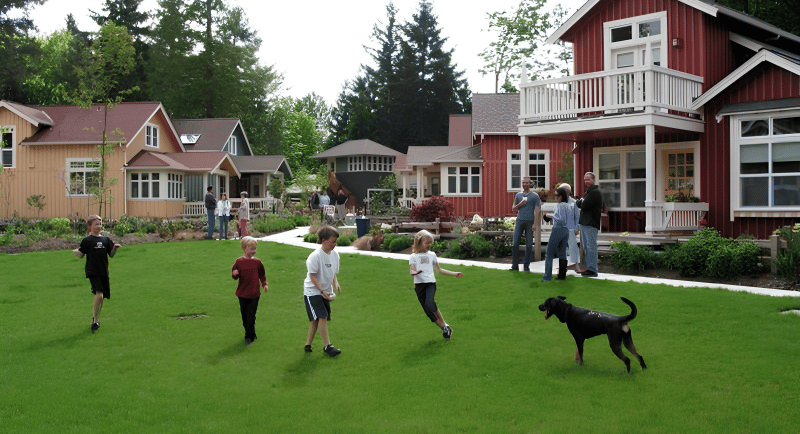
Years later, while visiting cohousing communities and learning everything I could about the movement, I came across a phrase that immediately brought those childhood memories rushing back. Architect Chuck Durrett talks about "life between the buildings." It's a remarkably simple idea, yet it captures something profound. Traditional suburban neighborhoods are often designed around streets, driveways, garages, and private backyards. Cohousing communities, by contrast, are intentionally designed around pedestrian pathways, shared green spaces, and places where neighbors naturally cross paths throughout the day.
That distinction may seem subtle, but it changes the rhythm of everyday life. The design itself doesn't create community—people do. What thoughtful design can do is make community easier. A walk to check the mail becomes a conversation. Watering flowers turns into helping a neighbor harvest tomatoes. Children playing outside become the reason parents get to know one another. Those interactions aren't scheduled, and they aren't required. They simply become part of daily life.
That idea resonated deeply with me because it put words to something I had been feeling for years. In an earlier article, A Neighborhood Where You Belong, I wrote about our universal desire to know our neighbors and to feel connected to the place we call home. I believe most of us aren't looking for constant social activity. We're simply looking for the comfort of belonging somewhere. The spaces between the homes are often where that sense of belonging begins.
As we've worked with Studio CoHab to design Gratitude Village Brighton, I've come to appreciate just how much thought goes into those seemingly ordinary spaces. We've spent surprisingly little time talking about roads compared to the time we've spent talking about pathways, gathering places, gardens, and preserving the beautiful cottonwood grove on the north side of the property. We've discussed where children might naturally play, where neighbors might linger after checking their mail, and how the Common House can become part of everyday life rather than a building reserved for meetings and special occasions.
Those conversations may sound like design decisions, but they're really community decisions.
In Shaping the Village Together, I shared how our future residents are helping make those decisions through collaborative design workshops. They're not simply reviewing floor plans or selecting finishes. They're imagining how life will unfold years from now. Where will children feel safe to explore? Where will someone enjoy a quiet cup of coffee while still feeling connected to the neighborhood? Where will neighbors gather for an impromptu conversation after dinner? Those questions are every bit as important as deciding where the buildings should be placed.
In many ways, we're already experiencing a glimpse of that community. Long before construction has begun, founding members are building friendships, sharing meals, celebrating milestones, solving problems together, and supporting one another through life's challenges. That's something I reflected on in Building Community Before the Homes Exist. One of the beautiful surprises of cohousing is that the community often begins long before the first foundation is poured.
When I first started visiting cohousing communities more than a decade ago, I thought I was searching for a different kind of housing. Looking back now, I don't think that was ever really true. I wasn't searching for smaller homes, energy-efficient construction, or even a Common House. Those are all important, and they'll certainly be part of Gratitude Village. But what I was really searching for was the feeling I had experienced as a child—a neighborhood where people naturally knew one another because life happened in shared spaces instead of behind closed doors.
That realization eventually led me to create Gratitude Village. As I shared in When a Dream Becomes a Place, I spent years hoping I would someday find the community I was looking for before realizing that perhaps the community I imagined simply hadn't been built yet. That realization changed the course of my life.
I don't expect Gratitude Village to recreate my childhood neighborhood in Denver or those summer evenings in western Oklahoma. Every community develops its own traditions, its own stories, and its own personality. But I do hope we're creating a place where children can ride their bikes until dusk, neighbors stop to talk without checking the time, and someone always seems to be outside enjoying the evening. I hope future residents remember shared meals in the Common House, conversations beneath the cottonwood trees, gardens that produced both vegetables and friendships, and neighbors who became lifelong friends.
The homes themselves will provide comfort, safety, and shelter. But years from now, I doubt anyone will remember the exact square footage of their home or where every wall was located. What they'll remember are the moments that transformed a collection of houses into a community.
Those moments happen in the spaces between the homes.
COMMUNITY
Join us in embracing nature, diversity and connection.
Sustainability
DIVERSITY
info@gratitudevillageco.com
720-689-4821
© 2026. All rights reserved.
AFFORDABILITY
Gratitude Village Inc. is a 501(c)3 charitable corporation (public charity) that values diversity, equity and inclusion as essential to our mission. EIN #33-2499522
Subscribe to our Substack
Refund Policy


Gratitude Village is a Proud Member of these organizations