Oct 22, 2026 Zoom Info Session - 5:30-6:30pm REGISTER to get the link!
What Is Cohousing? (And What It Isn't)
Cohousing is often misunderstood. Some people imagine a commune, while others picture a retirement community or shared housing. In reality, cohousing is a neighborhood intentionally designed to encourage connection while respecting privacy and independence. In this post, we explore what cohousing is, what it isn't, the six principles that define it, and how Gratitude Village is building on the cohousing model to create accessible, sustainable, and connected neighborhoods where people truly know, support, and care for one another.
Gratitude Village
7/24/20267 min read
Ask ten people what cohousing is, and you'll probably get ten different answers. Some imagine a commune. Others picture a retirement community or a cluster of tiny homes. The reality is both much simpler and much more interesting. Cohousing is a neighborhood intentionally designed to encourage connection while respecting privacy, and understanding what it is—and what it isn't—is often the first step toward imagining a different way to live.
One of my favorite conversations about Gratitude Village happens over and over again with my neighbor across the street. We grew up together as young girls. For a time, we were best friends. Our moms were Girl Scout leaders together, and many of my childhood memories include her and her brother. As we grew older, our lives took different paths. I moved to Massachusetts, spent time in Peru, and later lived in Santa Fe, New Mexico. She moved to Anchorage, Alaska. Careers happened. Families happened. Life happened.
Then something unexpected brought us both home. After our parents passed away, we each returned to our childhood homes. Today, we once again live across the street from one another—something neither of us could have imagined all those years ago.
Whenever I tell her about Gratitude Village, she's genuinely excited for me. She asks questions, follows our progress, and cheers us on. But eventually she smiles and says, "Suzie…you're building a commune." Her 93-year-old father usually comes to my defense.
"No," he'll say with a grin. "That's not what she's talking about."
My neighbor isn't convinced.
"I'll believe it when I see it."
Honestly, I don't blame her. For many people, cohousing is a new idea, and when we encounter something unfamiliar, our minds naturally compare it to something we already know. Sometimes that comparison is a commune. Sometimes it's an apartment complex. Sometimes it's a retirement village, a bunch of tiny homes in a circle or simply a neighborhood with a clubhouse.
None of those descriptions are quite right.
So...what is cohousing?
At its heart, cohousing is an intentional neighborhood where residents own their own private homes while sharing thoughtfully designed spaces that encourage connection, cooperation, and a sense of belonging. Unlike conventional developments, where homes are designed first and community is left to chance, cohousing begins with a different question:
How can we design a neighborhood that helps people become neighbors?
The National Cohousing Alliance describes cohousing as neighborhoods intentionally designed to encourage interaction while respecting each household's privacy and independence. It's a simple idea, but one that has been successfully demonstrated in hundreds of communities around the world.
Think of it this way: in a conventional subdivision, community may happen by chance. In a cohousing neighborhood, the community is intentionally designed to help those connections happen naturally.
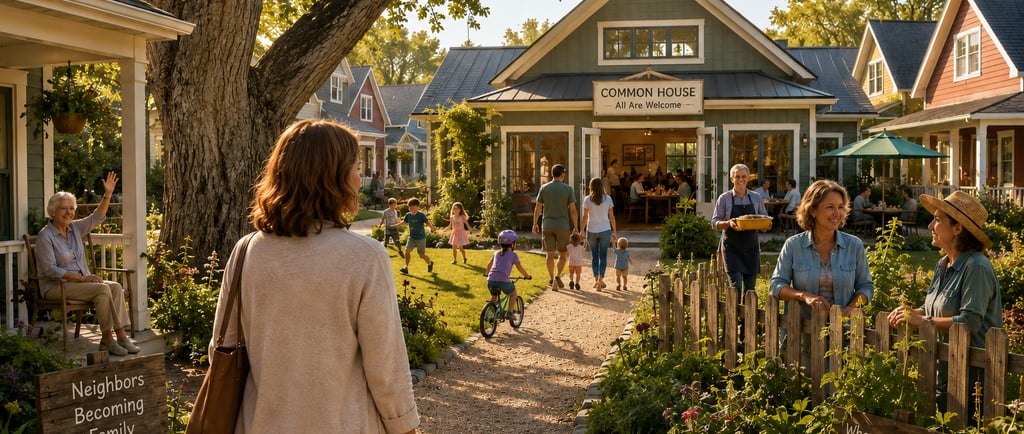
Homes are typically arranged around shared outdoor spaces rather than garages and busy streets. Walkable pathways and deep, welcoming front porches encourage neighbors to cross paths throughout the day. A Common House provides space for shared meals, celebrations, meetings, guest accommodations and activities that are easier—and often more enjoyable—to share. Yet every household has its own complete private home with its own kitchen, living room, bedrooms, and outdoor space.
The goal isn't to live together in the same house, like many of us did in college. The goal is to live well together as neighbors.
What Makes a Neighborhood Cohousing?
While every cohousing community reflects the people who create it, the most successful communities share several core principles.
Resident Participation
Future residents help shape both the physical neighborhood and the culture of the community long before construction is complete. As I shared in Building Community Before the Homes Exist, relationships don't begin on move-in day—they begin months and often years before the first home is built. Residents aren't simply buying a home—they're helping create a neighborhood.
Thoughtful Design
The layout of the community encourages everyday interaction. As I explored in The Spaces Between the Homes, it's often the pathways, gardens, porches, and shared gathering places—not the homes themselves—that create opportunities for neighbors to connect. Homes face common spaces, pedestrian pathways replace streets wherever possible, and gathering places invite people to spend time together.
Private Homes
Every household owns its own home, complete with its own kitchen, living areas, bedrooms, bathrooms, and private outdoor space. Privacy isn't sacrificed—it is respected. Active areas like the kitchen or home office face into the community while living rooms and beds are tucked at the back of the home.
Shared Spaces
Features such as a Common House, gardens, workshops, playgrounds, guest rooms and outdoor gathering spaces allow neighbors to share resources while creating opportunities to build relationships.
Resident Management
The people who live in the community also help care for it. Residents work together to make decisions, organize activities, maintain shared spaces, and shape the culture of their neighborhood.
Community by Choice
Perhaps the most important principle is that community isn't forced—it is chosen. As I wrote in Community Is Powerful—But It Isn't Magic, meaningful relationships don't simply appear because people live near one another. They grow through shared experiences, communication, and a willingness to keep showing up for one another. The neighborhood is intentionally designed to create opportunities for connection while always respecting each person's independence, privacy, and personal boundaries.
What Cohousing Isn't
Sometimes it's easier to explain cohousing by talking about what it isn't.
It isn't a commune.
This is probably the most common misconception. Residents don't share income, bank accounts, property, or possessions. Every household owns its own home, manages its own finances, prepares most of its own meals, and lives independently. The shared spaces exist because people choose to enjoy certain parts of community life together—not because they're giving up their independence.
It isn't a retirement community.
While many older adults are drawn to cohousing because of the relationships and support it offers, most communities are intentionally multigenerational. Children, young adults, families, empty nesters and older adults all contribute to the life of the neighborhood.
It isn't a place without privacy.
One of the biggest surprises for first-time visitors is just how private cohousing feels. You can close your front door and enjoy complete solitude whenever you wish. The difference is that when you choose to step outside, you're likely to find neighbors who know your name. I was also initially surprised at how many introverts live in cohousing, although, now that I know and understand better many introverted people, it makes sense to me.
Participation isn't mandatory.
Some people imagine a calendar full of required meetings and endless community activities. In reality, participation ebbs and flows with the seasons of life. A young parent may contribute differently than a retiree. Someone recovering from surgery may participate less for a time. Others may enjoy organizing shared meals, gardening, maintaining common spaces, or serving on committees. Community isn't measured by attendance—it grows through a willingness to contribute in ways that make sense for each individual.
In many ways, cohousing simply creates opportunities. Whether you choose to take advantage of those opportunities is entirely up to you.
How Gratitude Village Builds on the Cohousing Model
When I first discovered cohousing, I knew I had found something important.
Here was a neighborhood model that intentionally addressed one of the greatest challenges of modern life: loneliness. It recognized that relationships don't simply happen because houses are built next to one another. Community can be nurtured through thoughtful design, shared experiences, and intentional participation.
But as I continued learning, another question emerged. What if we could build on that foundation?
Gratitude Village didn't begin with the goal of creating another cohousing community. It began with a broader vision: how could we create neighborhoods that also address housing affordability, accessibility, environmental sustainability and long-term resilience while preserving everything that makes cohousing so powerful?
That question became the foundation of Gratitude Villages, our non-profit.
In addition to the principles of cohousing, our communities are being designed around five additional commitments.
Universal Accessibility
Homes, pathways, and community spaces are designed so people of all ages and abilities can live comfortably, safely, and independently throughout every stage of life.
Zero Energy Living
High-performance homes are designed to dramatically reduce energy consumption, lower utility costs, improve comfort, and lessen environmental impact.
Mixed-Income Homeownership
We believe diverse communities are stronger communities. Gratitude Village intentionally creates opportunities for households with a range of incomes to become homeowners and neighbors.
Long-Term Affordability
Through partnerships with community land trusts and other innovative housing strategies, we are working to preserve affordable homeownership opportunities for future generations rather than allowing affordability to disappear over time.
A Replicable Development Model
Brighton is only the beginning. Every lesson we learn is helping create a model that can be adapted and replicated by other communities seeking to address many of today's most pressing housing and social challenges.
Why This Matters
Our communities are facing challenges that traditional neighborhood design was never intended to solve.
Loneliness affects people of every generation. Housing affordability continues to place homeownership out of reach for many families. Older adults often want to remain connected to their communities as they age. Parents wish their children had more trusted adults in their lives. Neighborhoods become stronger when people of different ages have opportunities to know, support, and learn from one another. Many people simply long to know the names of the people living next door.
Cohousing isn't a cure-all but it offers a different way of thinking about neighborhoods. It reminds us that while architecture creates houses, thoughtful design can also help create belonging.
That's why I smile every time my neighbor tells me I'm building a commune.
She's asking the same question that many people ask the first time they hear about cohousing. And honestly, if I hadn't spent years learning about intentional communities, I might have wondered the same thing.
Someday, when she's walking through Gratitude Village—stopping to chat with neighbors, watching children play beneath the cottonwood trees, and sharing coffee in the Common House—I suspect she'll stop, look around, and smile.
"Oh...
Now I get it."
And I have a feeling she'll discover what so many others have discovered before her. It was never about building a commune. It was always about building a neighborhood where people truly know one another - like the one we had when we were growing up together.
COMMUNITY
Join us in embracing nature, diversity and connection.
Sustainability
DIVERSITY
info@gratitudevillageco.com
720-689-4821
© 2026. All rights reserved.
AFFORDABILITY
Gratitude Village Inc. is a 501(c)3 charitable corporation (public charity) that values diversity, equity and inclusion as essential to our mission. EIN #33-2499522
Subscribe to our Substack
Refund Policy


Gratitude Village is a Proud Member of these organizations